Here’s the strange thing about international trade: you’re often asked to trust someone completely, without ever shaking their hand.
No warehouse visit. No sitting across a table sizing each other up. Just an email signature, a few WhatsApp messages, and — if you’re lucky — a sample box that arrived mostly intact.
Everything else in this list — the paperwork, the samples, the calls, the trial order — exists to do the job that handshake was supposed to do.
India has a large agricultural export industry: rice, spices, fruits, vegetables, pulses, tea, turmeric, and plenty more. But a big export industry isn’t automatically a consistent one. Suppliers vary wildly in how they source, how they check quality, and how much real export experience they’re carrying around versus simply claiming.
If you’re an overseas buyer hunting for an Indian supplier, here’s how to build that missing handshake yourself, one piece of evidence at a time.
1. Verify the Exporter’s Business
Start with the paperwork, because paperwork is the closest thing to a handshake you’ll get on day one.
At minimum, get:
- Legal business name and address
- Importer Exporter Code (IEC)
- GST details, where applicable
- Relevant registrations
- Company email and contact details
- The name of the actual person handling your order
Cross-check the exporter against official databases like APEDA’s exporter directory. Five minutes, and you’ll know whether the company is who it says it is.
Registration alone won’t make them reliable — plenty of properly registered companies are still mediocre suppliers. But it’s the floor, not the ceiling. You can’t skip it and hope to make it up later.
2. Check Their Experience With Your Product
“We handle agricultural products” is doing a lot of quiet work in that sentence. It doesn’t mean they know your product.
Say you’re buying Indian pomegranates. Ask:
- Which varieties do you supply?
- Where are they sourced from?
- What grades and sizes are available?
- What’s the export season?
- What packaging options do you offer?
- Which markets have you supplied before?
Swap “pomegranates” for rice, spices, onions, bananas, or pulses. The questions barely change.
An exporter who genuinely knows your product talks about its quality, availability, specifications, and seasonality like it’s second nature. One who doesn’t will talk in circles, and circles are where deals go to die.
3. Define Product Specifications Clearly
Never mistake the product name for the full specification.
“Indian rice.” “Fresh mangoes.” Either phrase can mean a dozen different products depending on variety and grade. The gap between what you pictured and what shows up at port? That’s exactly where good deals turn bad.
Get specific, and get it in writing:
- Variety and grade
- Size
- Moisture or purity requirements
- Packaging
- Net and gross weight
- Shelf life
- Origin
- Required testing or certifications
- Labelling requirements
Clear specs don’t guarantee a perfect shipment. But vague ones practically guarantee an argument later.
So far, this is all stuff you can check from your desk. The next few take a little more legwork — but they’re where you actually start to see the exporter, not just their paperwork.
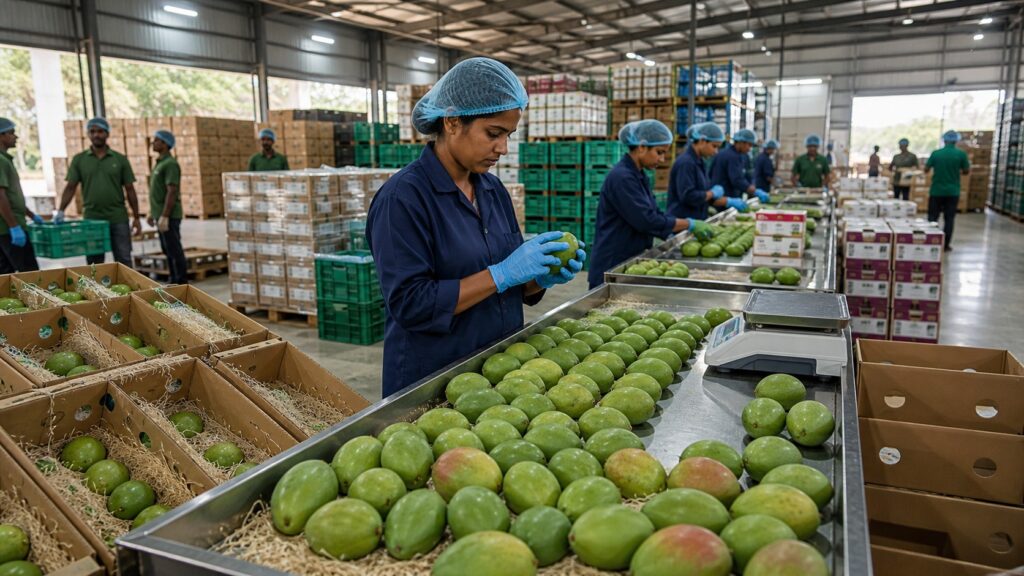
4. Request Samples
If you’re working with a new supplier, a sample is the cheapest insurance you’ll ever buy.
Depending on the product, evaluate:
- Quality
- Size and appearance
- Purity
- Packaging
- Taste or physical characteristics
- Overall consistency
Here’s the part buyers forget to ask: does this sample actually represent what ships? A gorgeous sample followed by an inconsistent commercial shipment isn’t a win. It’s a warning, dressed up as one.
5. Understand the Sourcing Process
Ask where the product actually comes from.
Farmers, FPOs, agricultural markets, processors, packhouses, established suppliers, their own facilities — exporters source in all sorts of ways, and no single model is automatically “the right one.”
What matters is control. Does this exporter have enough grip on their supply chain to deliver what you need, consistently, order after order — not just this one, lucky time?
For seasonal products, push further. Ask about availability during your required window specifically. “We can usually get it” and “we will have it in March” are two very different sentences.
6. Ask About Quality Control
A quality problem doesn’t just cost money. It turns a profitable shipment into an expensive lesson.
Ask directly:
- How is the product inspected before shipment?
- Where is it packed?
- Is laboratory testing available where required?
- Can third-party inspection be arranged?
- How are damaged or rejected goods handled?
Certain products and destinations carry specific testing and traceability requirements. Settle those before you confirm the order — not after the container’s already at sea and it’s too late to ask nicely.
Paperwork and product, sorted. Now for the part that actually decides whether this relationship survives past one shipment.
7. Confirm Export Documentation
Agricultural exports come with almost as much paperwork as product. Depending on the product and destination, you may need:
- Commercial invoice
- Packing list
- Certificate of origin
- Phytosanitary certificate
- Inspection or laboratory certificates
- Shipping documents
Skip the vague version of this question. “Can you provide all documents?” gets you a vague “yes,” every time. Ask instead: “Which documents will you provide for this specific product and destination?”
Same topic. Completely different, and far more useful, answer.
8. Pay Attention to Communication
Communication is the closest thing you get to that missing handshake, just stretched out over weeks instead of one moment.
Notice whether the exporter:
- Responds consistently
- Understands your specifications
- Gives clear quotations
- Provides realistic timelines
- Communicates changes proactively
- Gives shipment updates
Nobody needs a reply at 11 p.m. What you actually need is simpler than that: communication you could set your calendar by.
9. Compare Quotations Properly
Please don’t pick an exporter just because the number at the bottom of the quote happens to be the smallest.
First, check you’re comparing the same thing:
- Product specification
- Quantity
- Packaging
- Incoterm
- Port of loading
- Destination
- Insurance
- Inspection
- Documentation
- Payment terms
- Delivery timeline
An FOB quote and a CIF quote are not the same number in different outfits. They cover entirely different things, and lining them up on price alone is a bit like comparing rent to a mortgage payment and calling one “the better deal.”
Compare like-for-like offers. Anything else is just guessing, with extra steps.
10. Discuss Payment Terms Carefully
Settle payment terms before you confirm the order — not while the shipment’s already moving and your leverage has left with it.
Depending on the transaction, that might mean advance payment, letters of credit, documentary collections, or another structure entirely. For a first transaction especially, verify the supplier and the transaction itself before any real money changes hands.
There’s no single “correct” structure here. The right one depends on order size, how well you know the exporter, country risk, and a handful of other commercial factors worth actually thinking through, not skipping past.
Everything above gets you through one shipment safely. These last three are about whether you’d want a second.
11. Look for Relevant Export Experience
“We’ve been in business for 10 years” sounds reassuring. It also tells you almost nothing.
Ask instead:
- Which products have you exported?
- Which countries have you supplied?
- What quantities can you normally handle?
- Which ports do you regularly ship from?
Ten years of selling something else, somewhere else, isn’t the experience you’re actually buying. Relevant experience beats a longer résumé, every single time.
12. Consider a Trial Order
If it’s your first time working with a particular exporter, start smaller where it’s commercially practical. Call it a handshake in miniature — small enough to survive if it goes wrong, real enough to mean something if it goes right.
A trial shipment lets you evaluate:
- Product quality
- Packaging
- Documentation
- Communication
- Shipment handling
- Timeliness
- Overall reliability
One good first shipment won’t guarantee the next twenty. But it buys you something a sales call never can: proof, instead of a promise.
13. Don’t Judge an Exporter by Their Website Alone
A polished website is nice. It’s also not proof of anything — websites don’t ship containers, people do.
The real test is whether the exporter can walk you through, in actual detail:
Sourcing → Quality → Specifications → Documentation → Logistics → Pricing → Delivery
A website tells you what a company says about itself. A real conversation tells you how it actually operates. Those aren’t always the same company — and a conversation is about as close as you’ll get to the handshake you never had.
Quick Checklist for Buyers
Save this. Screenshot it. Whatever gets it in front of you again before you sign anything.
- Verified the exporter’s business details
- Checked relevant registrations
- Confirmed their experience with your product
- Clearly defined product specifications
- Evaluated samples where appropriate
- Understood their quality-control process
- Confirmed testing and inspection requirements
- Agreed on required export documents
- Confirmed Incoterms and shipping details
- Compared quotations on the same basis
- Agreed on payment terms
- Established a clear delivery timeline
- Evaluated their communication and reliability
Final Thoughts
Choosing an agricultural exporter in India shouldn’t come down to price alone. It rarely should — and yet it usually does, which is how most bad shipments start.
A reliable exporter gives you consistent product quality, dependable supply, proper documentation, transparent communication, and logistics that actually work. That’s the whole list. It sounds simple because it is simple. It’s just not common.
For a first transaction, take the time: verify the supplier, clarify specifications, evaluate samples, agree on terms — before you commit, not after.
You were never going to get the handshake. But you can build everything a handshake was supposed to tell you: that this person does what they say, ships what they promise, and picks up the phone when something goes wrong.
The goal was never just to find an Indian exporter. Anyone can find one of those.
It’s to find one you’d trust with next month’s shipment. And the one after that. And the one after that.