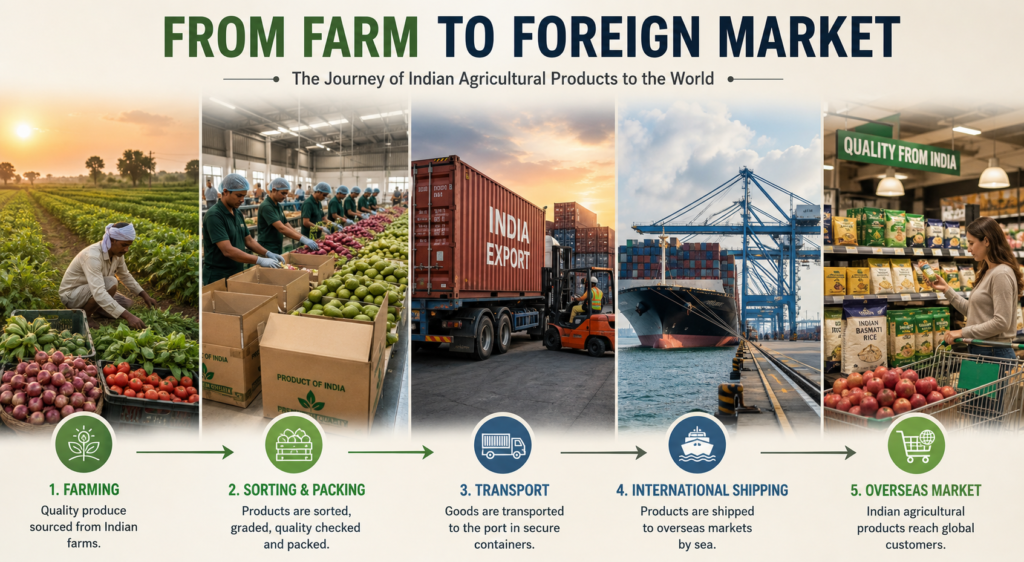
You spot Indian agricultural products on a shelf somewhere overseas. Looks simple enough. It isn’t — a lot happens behind the scenes before that product ever gets there.
A shipment of rice, bananas, pomegranates, onions, turmeric or ginger moves through several stages before it reaches an overseas buyer: product selection, quality requirements, pricing, documentation, logistics, customs, and no shortage of coordination between people who may never meet in person.
New to international trade? This can look complicated from the outside. Break it into steps, though, and it stops looking that way.
The Agricultural Export Journey at a Glance
Product → Buyer → Quotation → Agreement → Preparation → Documentation → Customs → Shipment → Import → Delivery
The exact path shifts with the product, the destination, the regulations, the terms agreed upon. But the major stages below? Those hold steady.
1. It Starts With the Product
Before an agricultural product can reach an overseas market, the exporter has to know — precisely — what’s being sold.
Sounds obvious. It isn’t. Agricultural products are rarely as simple as “I want to buy onions” or “I want 10 tonnes of rice.”
Buyers may have specific requirements for:
- Variety
- Grade
- Size
- Moisture level
- Quality
- Appearance
- Quantity
- Packaging
- Shelf life
- Harvest or production period
And that shifts from market to market.
A pomegranate buyer usually cares about size, appearance, packaging and quality. A rice buyer cares about variety, grain characteristics, broken percentage and packaging format. Same word, “buyer” — very different checklist.
So the export process doesn’t really begin with a product name. It begins with a product’s specifications.
2. Finding an Overseas Buyer
Product identified, market understood — now comes the harder part: finding a buyer.
That buyer could be an importer, a wholesaler, a distributor, a retailer, or any other business purchasing the product for its own use or for resale.
The initial discussion usually revolves around questions such as:
- What product is required?
- How much is needed?
- What quality or grade is expected?
- How should it be packed?
- Where is the shipment going?
- When is it required?
- What price and trade terms are being considered?
Communication matters here, more than people expect. Get the grade or the packaging even slightly wrong in the conversation, and it becomes a real problem later.
3. The Buyer and Exporter Agree on the Deal
Once both sides are clear on the requirement, the real work starts: agreeing on terms.
This normally involves several commercial details:
- Product: What exactly is being supplied?
- Quantity: How much is being purchased?
- Price: What is the agreed price?
- Packaging: How will the goods be packed?
- Payment terms: When and how will payment be made?
- Delivery terms: Who is responsible for which parts of the transportation process?
This is also where Incoterms enter the picture — the internationally recognized shorthand for who’s responsible for what, and who carries which costs and risks.
FOB and CIF: A Simple Example
| Term | General idea |
| FOB | The seller handles the agreed export-side responsibilities up to the specified point, while the buyer generally arranges the main international freight. |
| CIF | The seller generally arranges the main carriage and insurance to the named destination port, while destination-side responsibilities still remain with the buyer depending on the agreement. |
One caveat: always check the exact responsibilities against the specific Incoterm and named place actually being used.
For a beginner, the point worth remembering is this: the price of a product is rarely the same thing as the total cost of getting it to the buyer.
4. Preparing the Agricultural Products
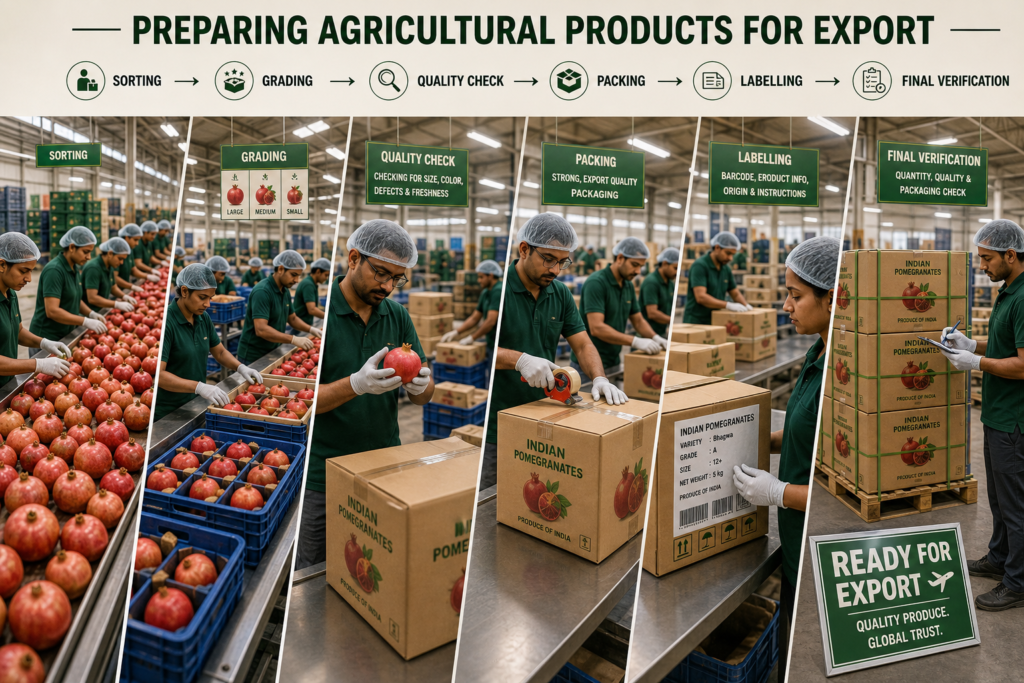
Commercial agreement done. Now the physical preparation begins.
This step counts for more with agricultural products than most — they’re sensitive to handling, storage, temperature, moisture, packaging and transportation conditions.
Depending on the product, preparation may involve:
- Sorting
- Grading
- Cleaning or processing
- Quality checks
- Packing
- Labelling
- Final quantity verification
Fresh produce needs extra care — it can deteriorate in transit.
And packaging is more than putting a product in a box. It has to protect the goods through handling and transport, while meeting the buyer’s requirements and whatever the destination country requires too.
5. Export Documentation
Paperwork is the least glamorous part of international trade. It’s also one of the most essential.
Different products, different destination countries, different documentation requirements — there’s no single checklist that fits every shipment.
| Document | General purpose |
| Commercial Invoice | Provides details of the commercial transaction, including the goods and their value |
| Packing List | Describes how the shipment is packed and what it contains |
| Certificate of Origin | Indicates the country of origin of the goods |
| Bill of Lading / Air Waybill | Provides details relating to the transportation of the shipment |
| Phytosanitary Certificate | Certifies plant-health compliance where applicable |
Other certificates, declarations or supporting documents may be needed too, depending on the commodity, the destination and the regulations in play.
Which is exactly why exporters need to understand the specific destination market’s requirements, rather than assuming one paperwork set fits all.
6. Customs and Logistics
Goods ready. Documents ready. Now the shipment has to move through the logistics chain.
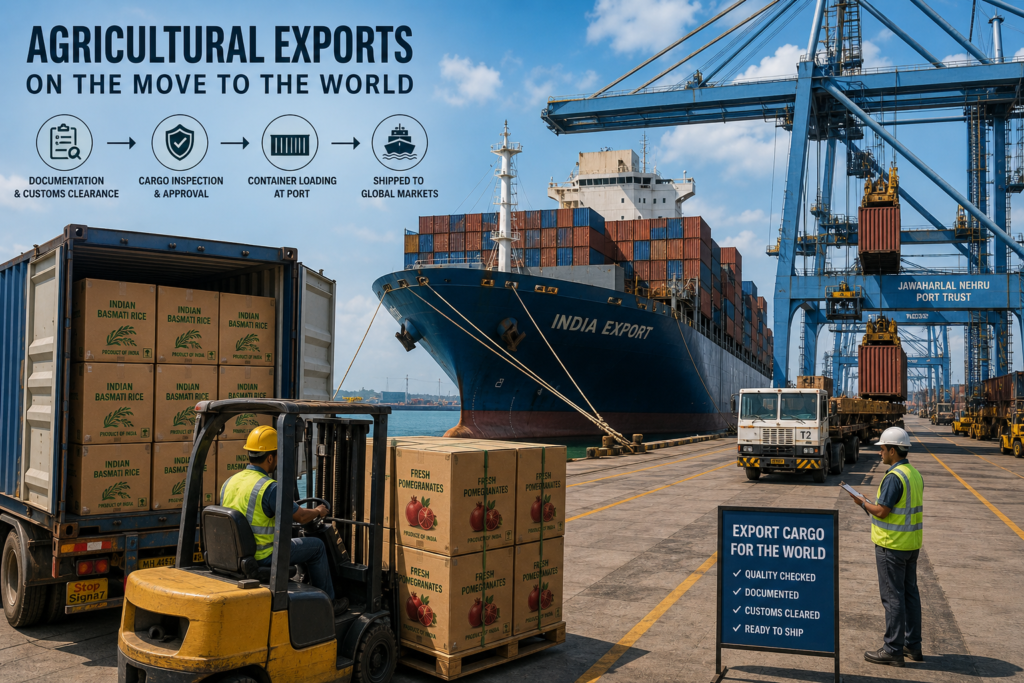
A freight forwarder or logistics provider may help coordinate parts of this process, depending on the arrangement.
Sea Freight
The default for larger commercial shipments, where the transit time allows for ocean transportation.
Air Freight
Faster — and sometimes the only real option when speed or the product itself demands it. The tradeoff: cost, and it can climb fast.
Before any of that, though, the goods still have to clear the relevant export procedures and customs formalities.
Accuracy matters here more than almost anywhere else in the process. A wrong figure in a document, a missing declaration — either can trigger delays and a cascade of complications.
7. The Shipment Reaches the Destination Country
The exporter’s job doesn’t end the moment the goods leave India.
Once the shipment reaches the destination country, the buyer or the responsible party under the agreed terms may need to handle import-side procedures.
Depending on the shipment and destination, this can include:
- Import customs procedures
- Document verification
- Inspections where required
- Duties and taxes
- Port or terminal charges
- Local transportation
- Final delivery
One more reason buyers and exporters should settle responsibilities before the shipment goes out — not after.
A deal can look perfectly clean on paper and still turn messy if neither side is sure who owns a particular cost or procedure.
8. Why Agricultural Exports Can Be More Complicated Than They Look
Moving a manufactured product internationally already takes coordination. Agricultural products add a layer most manufactured goods don’t have to deal with: the goods themselves are sensitive to time and handling.
For example, fresh produce can be affected by:
- Temperature
- Humidity
- Handling
- Transit time
- Packaging
- Storage conditions
Even the correct product, correctly purchased, can still be let down by poor coordination somewhere else in the chain.
Which is exactly why successful agricultural trade isn’t just about chasing the lowest price.
The product, the specifications, the packaging, the documentation, the logistics, the responsibilities between buyer and seller — all of it has to line up, together.
9. What Can Go Wrong?
Unclear Product Specifications
Read “premium quality” or “large size” differently, and both sides walk away disappointed — even when the shipment technically matches what was ordered.
Poor Packaging
Packaging that isn’t built for the journey raises the odds of damage or quality loss along the way.
Documentation Errors
Missing or incorrect information can stall customs clearance, or trip up other parts of the shipment.
Misunderstood Incoterms
When both sides aren’t clear on who owns which costs and responsibilities, unexpected expenses tend to show up later — always at the worst time.
Destination Requirements
A product can carry extra requirements once it lands in the destination country. Better to check for these before the shipment moves than discover them after.
Transit and Handling Problems
For agricultural products, a delay or a bit of rough handling does more damage than it would to most non-perishable goods.
The fix, in principle, isn’t complicated: clarify requirements before the shipment moves. Not after.
10. The Entire Process in One View
1. Select the product
↓
2. Understand the target market
↓
3. Find a buyer
↓
4. Confirm specifications and quantity
↓
5. Agree on price, payment and trade terms
↓
6. Prepare and pack the goods
↓
7. Complete required documentation
↓
8. Complete export procedures
↓
9. Arrange international transportation
↓
10. Buyer handles destination-side import procedures
↓
11. Goods are delivered
The details vary shipment to shipment. The basic journey doesn’t — it stays surprisingly structured.
11. Key Export Terms Beginners Should Know
Exporter
The business selling and sending goods to an overseas market.
Importer
The business purchasing goods from another country and bringing them into its market.
Incoterm
An internationally recognized trade term used to define certain responsibilities, costs and risks between buyer and seller.
FOB
A commonly used Incoterm in which the seller has defined responsibilities up to the named point at the port, while the buyer generally arranges the main carriage.
CIF
A commonly used Incoterm in which the seller generally arranges carriage and insurance to the named destination port, subject to the specific terms of the transaction.
MOQ
Minimum Order Quantity — the smallest quantity a seller is willing to supply under specified terms.
HS Code
A standardized classification system used to identify traded goods for customs and international trade purposes.
Freight Forwarder
A logistics company that can help coordinate the movement of goods and related transportation arrangements.
From Farm to Foreign Market
An agricultural export can start with something as ordinary as rice, onions, bananas, turmeric or pomegranates. Turning that into an international shipment, though, takes coordination at every single stage.
The exporter has to understand the product. The buyer has to state the requirement clearly. Both sides have to agree on terms. The goods have to be prepped right, the paperwork has to be in order, and the shipment has to clear logistics and customs — in that order, every time.
For someone entering international trade for the first time, all of this can look complicated from the outside. Break it into these stages, though, and it stops looking that way.
For businesses exploring agricultural sourcing from India, the most useful first step is rarely the flashy one. It’s simply understanding what has to happen before the goods ever leave the count