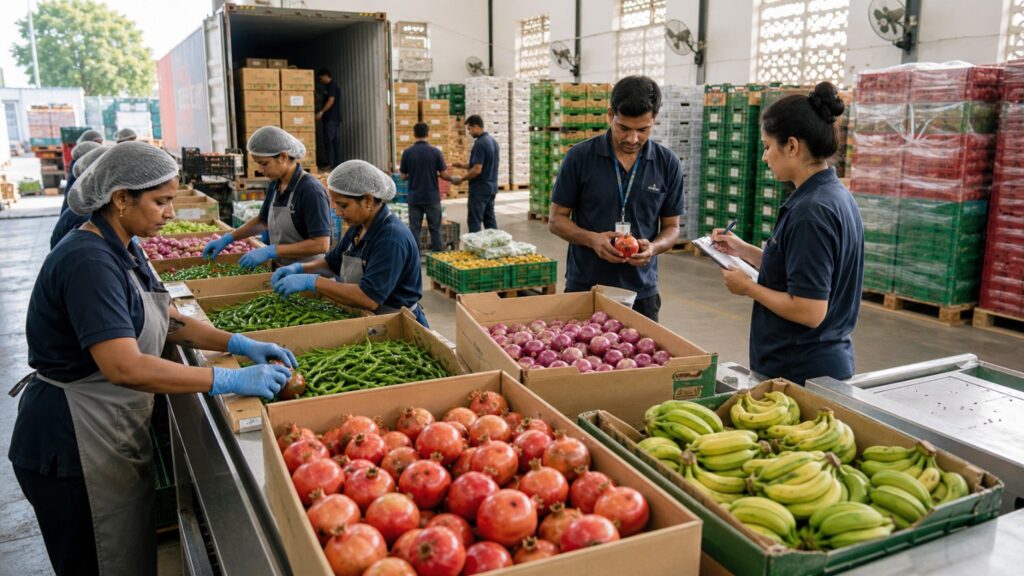
India grows an extraordinary share of what the world eats — onions, bananas, pomegranates, mangoes, rice, spices, tea, ginger, turmeric. Practically an entire pantry, grown across one country.
But buying agricultural products from India isn’t just a matter of finding a supplier and agreeing on a price. That part is easy. Anyone with WhatsApp and a calculator can manage that much.
The hard part is something else: making sure the product you discussed is the product that actually gets sourced, packed, documented, shipped, and lands on your dock looking like what you agreed to.
That gap — between what was promised and what shows up — is where things go wrong.
And they do go wrong. Recent trade alerts and industry reporting confirm it: Indian agricultural consignments have faced genuine border rejections over pesticide residues, food-safety issues, and other compliance failures. Underneath those headline problems sits a quieter, messier set of risks — vague specifications, inconsistent quality, patchy communication, unreliable suppliers, and shipments that simply don’t turn out the way they were sold.
None of this means Indian agricultural exports are unreliable. Far from it.
It means international buyers need to know exactly where the risk actually lives.
1. “Export Quality” May Not Mean Much
Here’s an easy way for a sourcing conversation to go sideways: vague language.
A supplier describes onions as “export quality.” Rice as “premium.” Fruit as “good quality.”
Sounds reassuring. Means almost nothing.
For an importer, those words are decoration — not information. What you need are numbers you can actually hold a supplier to.
An onion buyer cares about size in millimetres, variety, moisture, defects, packing method, and the allowable percentage of damaged bulbs. A rice buyer cares about grain length, broken percentage, moisture, foreign matter, variety. A fruit buyer cares about size, colour, maturity, appearance, shelf life.
Buyer guides on sourcing Indian onions tend to circulate the same warning signs: vague grades, a supplier who won’t send samples, prices that are suspiciously low, phytosanitary arrangements nobody can quite explain, and payment details that don’t match the company on the invoice.
The lesson isn’t complicated:
Never accept “good quality” when the order can be described more precisely.
Write the specification down — precisely enough that you and the exporter are picturing the exact same product.
2. The Sample Can Be Good While the Shipment Is Different
This is the situation that makes importers want to fling their phone across the room.
The sample looks good. The quote is attractive. You place the order.
Then the container shows up, and it’s a different mix of quality, size, grade, or condition than what you signed off on.
Agricultural products make this especially frustrating, because they come from living, seasonal supply chains — not an assembly line producing identical units. Quality shifts between farms, growing regions, harvests, even different lots from the same field.
Which means consistency deserves just as much scrutiny as the first sample. A supplier who produces one excellent sample bag is not automatically a supplier who can reproduce that quality at commercial volume, container after container.
For any order beyond a one-off, the real question isn’t “is this sample good?” It’s:
Can this supplier consistently source the agreed specification — not once, but every time?
3. Pesticide Residues Can Turn Into a Serious Commercial Problem
This isn’t a hypothetical. It’s happened, repeatedly, and it keeps happening.
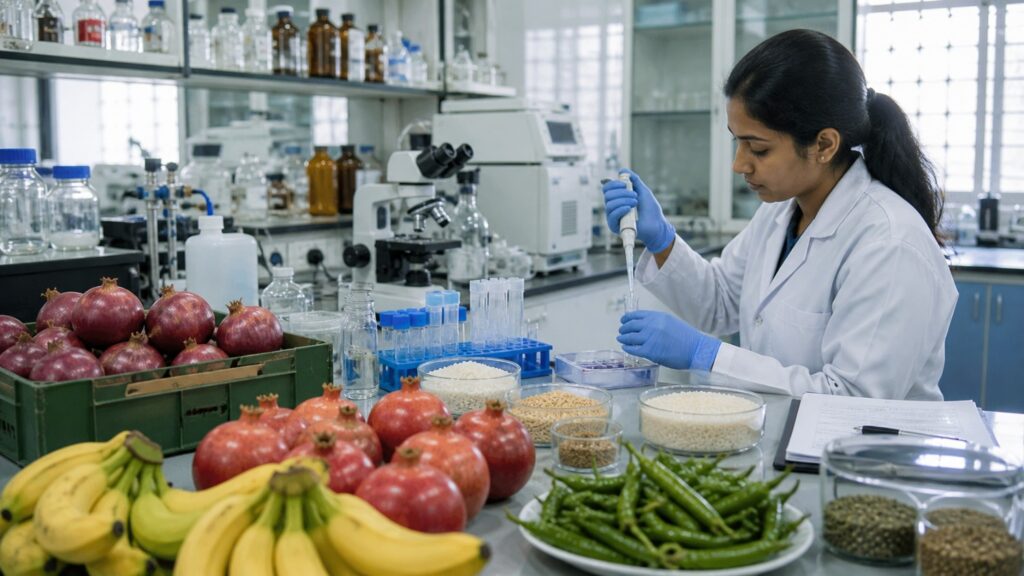
The EU’s food-safety alert system has flagged Indian rice — including basmati — for pesticide residues on multiple occasions in recent years, with chlorpyrifos among the more frequent names on the list.
Rice isn’t the only crop caught in this net. In 2026, Indian pomegranate exporters challenged the rejection of EU-bound consignments after testing turned up chlorpyrifos above the permitted limit — a finding confirmed by accredited laboratory testing and upheld on a second, referral test.
Zoom out, and the pattern holds. EU monitoring data shows repeated border-rejection notices involving Indian fruits, vegetables, peppers, and other agricultural products, with pesticide residues among the recurring reasons.
For a buyer, this is bigger than a lab report. A shipment that fails an import requirement means delays, added costs, rejection, lost product, and — often the most expensive part — damage to the relationship between you and your own customers.
That’s why compliance has to be handled before the container leaves India. Not after it lands.
4. Traceability Can Become a Weak Link
Underneath most residue and food-safety problems sits a simpler question: does anyone actually know where this product came from?
India’s agricultural supply chain often runs through several hands before it reaches an exporter. A farmer sells to an aggregator. The aggregator sells to a trader. The trader sells to the exporter. Somewhere in that chain, the paper trail tends to thin out.
Recent reporting on Indian farm exports has flagged exactly this — a fragmented chain in which records get vaguer the further you move from the farm gate, making it genuinely difficult to reconstruct what happened at the source.
For buyers operating under strict food-safety requirements, that matters. You need confidence not just in the product sitting in front of you, but in its history — what touched it, and when.
This is especially important if you’re supplying supermarkets, food manufacturers, or any regulated market that will eventually ask you the same question you’re asking your supplier right now.
5. Documentation Problems Can Stop a Good Shipment
A shipment can be full of perfectly good agricultural product and still get stopped cold — because the paperwork is incomplete, inconsistent, or wrong for the destination.
International agricultural trade runs on commercial documents, certificates, phytosanitary requirements, inspections, and a stack of destination-specific compliance rules. Exactly which rules apply depends on the product and the market.
Which means “all documents will be provided” isn’t an answer. It’s a hope.
What you actually need is confidence that the exporter understands which documents this specific shipment, to this specific destination, requires — not documents in general, but these documents, for this order.
A first-time exporter can be excellent at selling domestically and still badly underestimate what an international shipment demands. It’s one reason experienced buyers weigh execution capability just as heavily as price.
6. A Shipment Can Be Delayed After Everything Was Already Arranged
International logistics rarely depends on the exporter alone. Shipping routes, port operations, geopolitics, freight availability, payment channels — any of it can move the cargo, or stop it moving, regardless of how good the product is.
That turns into a serious problem fast when time is the whole point of the order.
Take basmati rice. Indian exporters faced major shipping and payment disruptions during the 2026 West Asia crisis — vessels avoiding key routes, cargo stranded at port, payments delayed, and, for anything time-sensitive, real concern about quality deteriorating while everyone waited it out.
So don’t just ask an exporter, “When will you ship?”
Ask the harder question:
“What’s the realistic end-to-end timeline — and what happens if something disrupts it?”
7. The Product Can Arrive in a Different Condition Than It Left
This one matters most with fresh produce.
On paper, everything checked out — the product was inspected, accepted, loaded. Done deal.
Except agricultural commodities keep changing after they leave the farm. Handling, temperature, ventilation, transit time, stacking, general care during the journey — all of it leaves a mark on the cargo.
For an importer, a shipment that arrives bruised, deteriorated, or with a fraction of its expected shelf life is a financial problem — full stop — even if it looked perfect the day it left India.
Which is really the point: packaging and logistics aren’t separate from product quality.
They are product quality.
8. Quantity and Commercial Condition Can Become Disputed
Sometimes the disagreement isn’t about quality at all. It’s about what actually showed up.
In Indian export circles, this is a familiar headache: a shipment clears at destination, and only afterward does the buyer report a shortfall — lower quantities, unexpected damage, “local expenses” — all cited as reasons to hold back part of the payment. Exporters swap enough of these stories that it’s treated as a known category of risk, not a freak occurrence.
The details of any single dispute are rarely provable from the outside, and one exporter’s account is never proof of a general industry practice. But the underlying lesson holds regardless of who’s telling the story:
Once the shipment is outside your direct control, evidence is everything.
Clear invoices, agreed specifications, loading records, inspection arrangements, photographs, weight records, and tightly defined commercial terms won’t prevent every disagreement. But they make the ones that do happen far easier to resolve.
9. The Biggest Risk May Be the Supplier, Not the Product
Buyers chasing the lowest price sometimes spend too little time on a more basic question: who, exactly, is on the other end of this deal?
That’s its own category of risk — and often the costliest one.
Indian sourcing circles carry recurring warnings about suppliers or intermediaries who:
- Quote prices dramatically below market
- Avoid sending samples
- Make big promises with no proof of capability behind them
- Push buyers to pay quickly
- Stay vague about company details
- Use payment accounts that don’t match the business they claim to represent
New exporters and buyers alike keep asking the same question in Indian trade circles: how do you verify who you’re actually dealing with, and avoid getting caught in a payment scam?
The answer isn’t “find the cheapest supplier.” It’s simpler, and less glamorous: confirm the company exists, confirm the people you’re emailing actually represent it, and get proof — not promises — of the capability they claim to have.
10. The Cheapest Quote Can Become the Most Expensive Shipment
Picture two quotes. One exporter offers $X. Another offers slightly more.
The cheaper one looks like the obvious pick.
Then the cheaper shipment shows up with:
- More rejected or damaged product
- Different grading than expected
- Extra inspection requirements
- Documentation problems
- Delays
- A shrinking shelf life
- A dispute over quantity or quality, just for good measure
That original price advantage? Gone. Fast.
This is why serious procurement decisions look past the invoice line. The better question isn’t “what’s the price.” It’s:
“What is my total commercial risk in choosing this supplier?”
How Can International Buyers Reduce These Risks?
You can’t eliminate every risk in agricultural trade. Weather changes. Harvests vary. Ships get delayed. Regulations move.
But a lot of the avoidable problems really are avoidable — if you deal with them before the shipment ever begins.
Start with a precise specification
Skip “premium quality.” Define what you actually need: grade, size, variety, packaging, quantity, acceptable tolerances, and any compliance requirements that matter for your market.
Ask for samples when appropriate
A sample can’t guarantee the whole shipment. But it will tell you, fast, whether the supplier actually understands what you asked for. Better to catch the mismatch now than after a container’s already loaded.
Verify the exporter
Check the company. The business identity. Export credentials. Communication history. Banking details. A polished website and an attractive quote are not proof of capability — they’re marketing.
Discuss destination requirements early
The product has to satisfy your market, not the exporter’s domestic understanding of “good enough.” That matters enormously for anything covered by pesticide-residue, phytosanitary, food-safety, or other import controls — and recent Indian export rejections show exactly how expensive that gap can get.
Agree on how quality will be checked
For anything beyond a small order, get specific: when and how the product is inspected, what documents confirm the result, and what happens if the shipment doesn’t match what was agreed.
Keep communication clear
A reliable supplier doesn’t go quiet the moment the purchase order is signed. You should be hearing from them — about sourcing, packing, documentation, shipment — without having to chase them down and ask what’s happening.
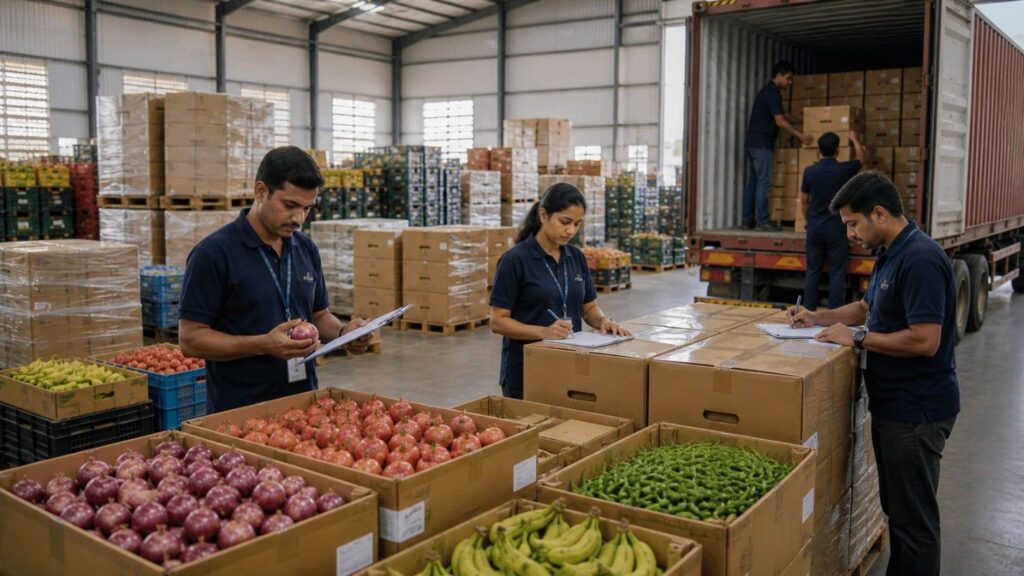
The Goal Is Not Zero Risk. It Is Better Risk Management.
Sourcing agricultural products from India can be genuinely rewarding. The country has enormous agricultural capacity, a remarkable range of commodities, and export relationships built up over decades.
But international sourcing gets a lot easier once buyers accept one thing: this transaction was never just a price and a product. It’s a chain.
Supplier → specification → sourcing → quality → compliance → packing → documentation → logistics → delivery
Weaken any single link, and the whole chain shows it.
That’s why the strongest sourcing relationships were never built around who could quote the lowest number. They’re built around something less flashy: whether the supplier can consistently deliver what was agreed, tell you when something changes, and manage the process from order to shipment without you having to babysit it.
Final Thought
Don’t ask an exporter, “Can you supply this product?”
Ask something sharper:
“Can you reliably supply this product to my specification, for my market, and manage the whole process properly — from sourcing to shipment?”
That question is the entire difference between finding an agricultural supplier and building one you can actually depend on.