Two quotations from an Indian exporter are sitting in your inbox.
FOB Nhava Sheva: $X/MT
CIF Jebel Ali: $Y/MT
The CIF price is higher, so FOB must be the cheaper deal. Right?
Not necessarily.
FOB and CIF aren’t just two ways of writing a price. They decide who books the main freight, who pays for insurance, where risk changes hands, and how much control you keep over the shipment. All of that lands in your actual import cost. The headline price only tells you where the arithmetic begins.
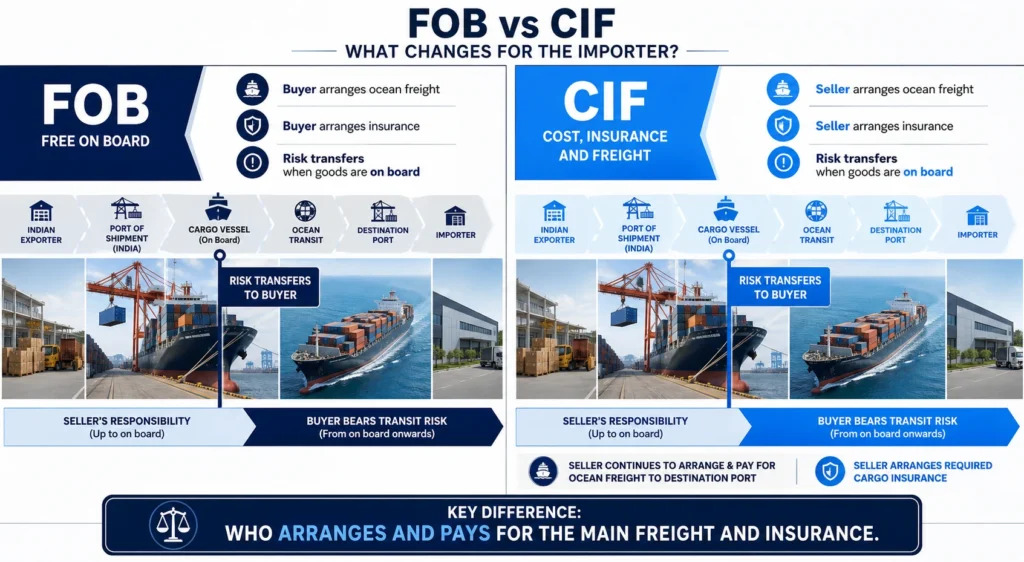
FOB vs CIF: The Core Difference
Both are Incoterms® 2020 rules for sea and inland-waterway transport. (Incoterms, if you haven’t met them, are the International Chamber of Commerce’s standard shorthand for who does what, who pays for what, and who carries the risk when goods change hands.)
FOB: Free On Board
Under FOB [named port of shipment], the seller delivers the goods on board the vessel you’ve nominated, at the agreed shipment port. The seller handles export formalities and loads the cargo.
Then it’s over to you.
Risk passes to you the moment the goods are on board. Main carriage is yours to arrange. So, in practice, is insurance: FOB doesn’t require either party to buy it, but you’re the one carrying the risk, so you’ll want cover.
CIF: Cost, Insurance and Freight
Under CIF [named port of destination], the seller also delivers the goods on board the vessel at the shipment port. Same handover point as FOB.
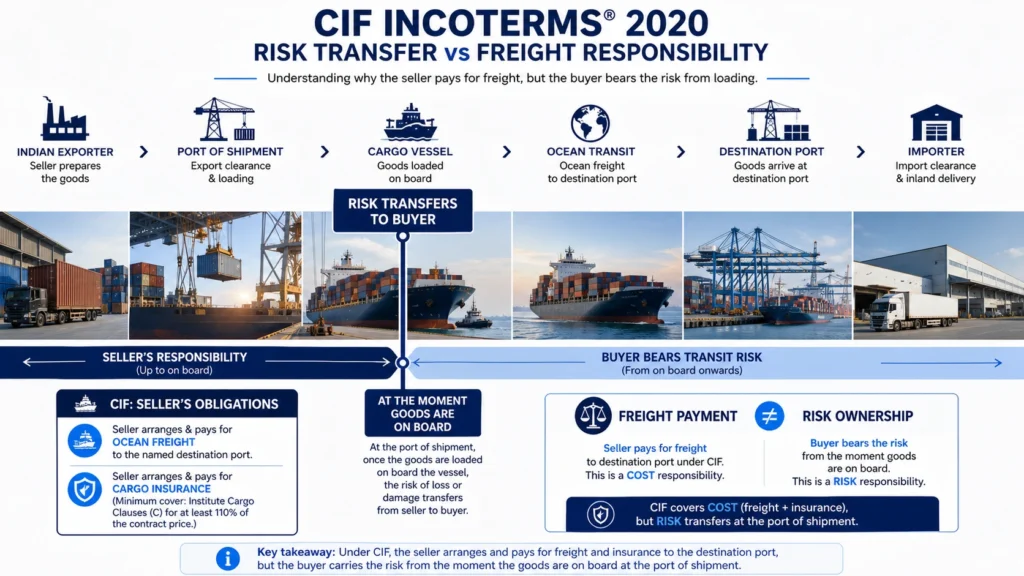
The name, though, plays a trick on you. “Destination” sits right there in the price, so it sounds as if the seller’s responsibility runs all the way to the destination port. It doesn’t. Risk still passes to you at the shipment port, not when the cargo arrives. (Yes, the name is misleading. No, it isn’t your fault.)
What the seller takes on instead: contracting and paying for ocean freight to the named destination port, and arranging cargo insurance.
Risk Transfers Earlier Than the Price Suggests
Take a shipment of Indian onions sold CIF Jebel Ali.
The exporter clears the cargo for export and loads it onto the vessel in India. That’s where the risk becomes yours.
The seller may keep paying for the ship to reach Jebel Ali. But paying for the voyage is not the same as carrying the risk on it. Under CIF, the freight obligation and the risk-transfer point are two separate things.
Then there’s insurance. Under CIF Incoterms® 2020, the seller must obtain the minimum cover the rule requires. That’s generally Institute Cargo Clauses (C), the most basic of the three clause levels, for at least 110% of the contract price. The broader Clause (A) is the minimum under CIP, not CIF. The parties can agree to more.
So don’t read CIF as “fully insured against everything.” Insured is an elastic word. Check the actual policy, the insured amount, the exclusions and the claims procedure.
FOB Isn’t Automatically Cheaper
Here’s a simplified example. The numbers are illustrative, not a market quote.
FOB value: $20,000
Ocean freight: $2,000
Insurance: $150
Add them up and your cost, before any destination-side charges, is roughly $22,150.
The exporter, meanwhile, quotes CIF destination at $22,700.
On the invoice, FOB looks $2,700 cheaper. Once you add freight and insurance, the gap shrinks to $550. And that $550 exists only if you can actually get freight for $2,000.
Can you?
A large importer, or an exporter with strong shipping relationships, may get better freight rates than a smaller buyer. If your honest answer is “probably,” you don’t have a comparison yet. You have a hope.
So the right comparison isn’t FOB price versus CIF price. It’s this:
FOB price + freight + insurance + applicable buyer-side costs
versus
CIF price + applicable buyer-side costs
Now you’re comparing like with like.
CIF Does Not Mean “Delivered to My Warehouse”
Another easy mistake: reading a CIF quotation as a landed-cost quotation.
Say you receive this:
CIF Jebel Ali: $25,000
That price covers the goods plus the seller’s CIF obligations, including freight and the required insurance to the named destination port. It’s a price to the port. It isn’t a promise to your warehouse door.
You may still face destination-side costs such as:
- Customs clearance
- Import duties and taxes
- Terminal/port charges not covered by the seller’s carriage arrangement
- Inspection or regulatory costs
- Transport from the port to your warehouse
Who pays exactly what depends on the transaction and the contracts underneath it.
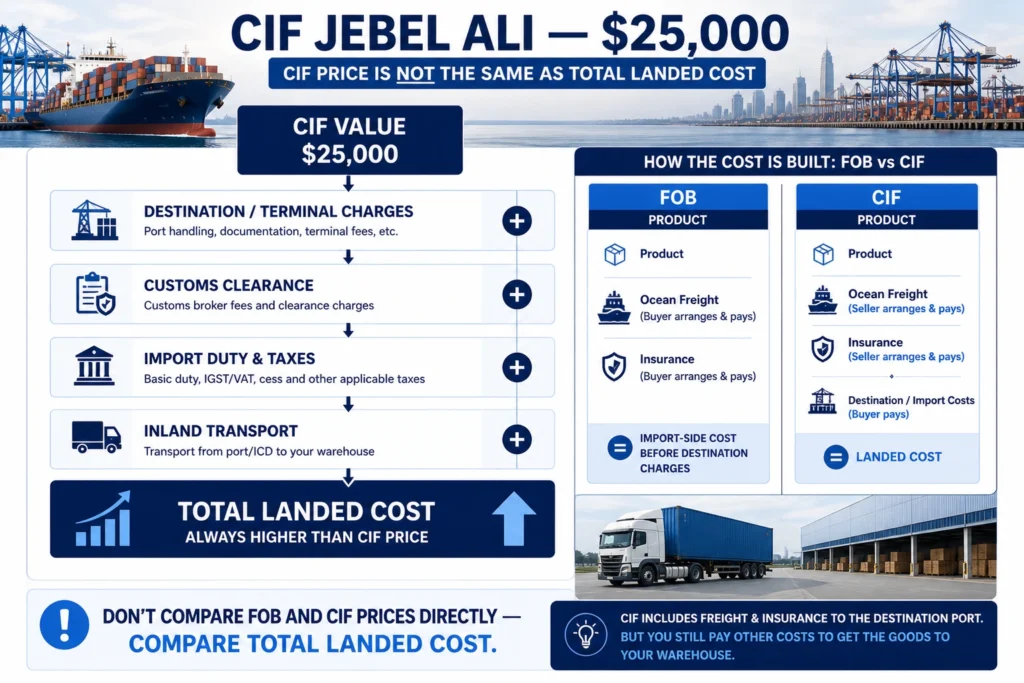
Here’s the full picture:
Total landed cost = product cost + freight + insurance + destination charges + duty/tax + clearance + inland delivery
The Incoterm settles only part of that sum.
When FOB Can Be Useful
FOB gives you control. That’s the whole pitch.
It works well when you already have:
- A freight forwarder or shipping agent
- Negotiated freight rates
- Your own cargo insurance arrangement
- A preferred shipping line or routing
- Regular import volumes
You choose how the cargo moves instead of relying on the exporter to arrange the international leg. It’s also easier to compare freight rates across shipments and suppliers.
But control isn’t free. It comes with coordination. The booking, the documentation, the vessel schedule and the insurance all need managing, and now they’re yours.
When CIF Can Be Useful
CIF suits buyers who’d rather not manage the main international transport themselves. You get a more complete shipping quotation from the supplier instead of arranging ocean freight separately.
It’s practical when:
- You import occasionally
- You’re new to the India trade lane
- You don’t yet have competitive freight arrangements
- The exporter has good access to shipping capacity or rates
The one non-negotiable: ask exactly what the CIF quote includes, and what’s still payable at destination.
One Technical Issue: Containers
This one is particularly relevant for agricultural exports.
FOB is designed for shipments where the seller delivers the goods on board the vessel. If containerized goods are handed to the carrier at a container terminal before they’re loaded onto the ship, the ICC points parties toward FCA rather than FOB. The same logic applies to CIF, whose container-friendly counterpart is CIP.
That doesn’t mean you’ll never see an Indian exporter quote “FOB Mundra” or “FOB Nhava Sheva” for container cargo. You may well. It means both sides should understand whether the chosen term matches where the goods physically change hands and where risk is meant to pass.
So with containers, talk to your freight forwarder before you settle on FOB just because it’s the term everyone knows.
What to Ask Before You Accept a Quote
Whether the offer is FOB or CIF, don’t stop at the headline price. Ask for:
- Exact product specification: grade, size, variety, moisture, tolerance, packaging and quantity.
- Named Incoterm and location: for example, CIF Jebel Ali, Incoterms® 2020, not simply “CIF Dubai.” Vague places invite arguments.
- Freight details: carrier, routing, estimated transit time and quote validity.
- Insurance details: coverage, insured value, exclusions and claims process.
- Destination charges: what’s included, and what you’ll pay after arrival.
- Documentation: commercial invoice, packing list, bill of lading and any product- or destination-specific certificates the shipment needs.
This matters even more for agricultural products, where a shipment’s commercial value can hinge on timing, condition and compliance.
So, Which Should an Importer Choose?
There’s no universal answer. (Annoying, but true.)
Choose FOB when you value control over freight and already have the logistics capability to manage it.
Consider CIF when you value simplicity, or when the exporter can arrange competitive freight and insurance.
The right call depends on your:
- Freight rates
- Shipment volume
- Insurance requirements
- Destination charges
- Logistics capability
- Cash and working-capital position
The cheapest-looking quotation isn’t always the cheapest shipment.
One Last Thing: Incoterms Don’t Cover Everything
FOB and CIF are precise about delivery, risk, costs, carriage and insurance. They’re silent on plenty else: payment terms, ownership and title, product specifications, dispute procedures, and how a quality dispute gets settled. Those belong in your sales contract.
So when two quotations land side by side, resist the obvious question: Which price is lower?
Ask this instead: What exactly am I paying for, when does risk become mine, and what costs and responsibilities stay with me after that?
Answer those three, then look at your two quotes again. They’ll read very differently.
FOB vs CIF at a Glance
| Item | FOB | CIF |
| Seller’s delivery point | On board vessel at shipment port | On board vessel at shipment port |
| Risk transfers | On board vessel | On board vessel |
| Main ocean freight | Buyer | Seller |
| Cargo insurance | Not obligatory (buyer’s call) | Seller (minimum cover) |
| Export clearance | Seller | Seller |
| Import clearance | Buyer | Buyer |
| Import duties/taxes | Buyer | Buyer |
| Final inland delivery | Buyer | Buyer, unless separately agreed |
The short version: FOB = you control the main freight. CIF = the exporter arranges the main freight and insurance for you. Either way, risk passes at the same place: on board the vessel at the shipment port.