A practical guide for international buyers comparing Indian agricultural suppliers and import costs
The price on an Indian supplier’s quotation is a real number. It just isn’t your number.
Your number is what the shipment costs once it has been loaded, shipped, cleared through customs and delivered to a place where you can actually receive it. Rice, pomegranates, onions, ginger, turmeric: whatever the product, that’s the figure your margin depends on. The quotation is merely where the arithmetic starts.
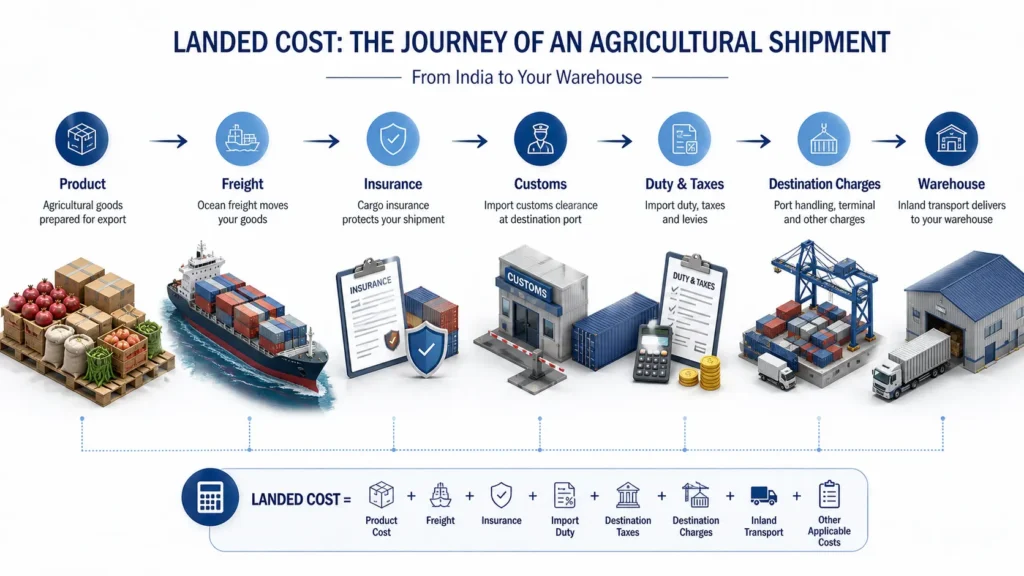
That arithmetic has a name: landed cost. It converts a supplier’s quotation into a far more realistic picture of what the goods will cost you by the time they reach the agreed receiving point. This guide takes it one cost at a time, with a worked example so you can watch the number grow.
What Is Landed Cost?
Landed cost isn’t a law of nature, and it isn’t a statute, either. There is no single official formula. It’s a practical commercial calculation that adds the purchase price to everything it takes to move, clear and receive the goods at your end.
Here is a working version:
Landed Cost = Product Cost + Freight + Insurance + Import Duty + Destination Taxes + Clearance/Port Charges + Inland Transport + Other Applicable Costs
Which of those lines apply, and how heavy each one is, depends on the product, the destination country, the shipment method and the Incoterm. That’s why the headline price on a quotation makes a poor basis for comparison.
1. Start With the Product Price (But Don’t Stop There)
Say you want to buy 10,000 kg of produce at an FOB price of USD 10,000. That works out to USD 1 a kilo, which looks refreshingly tidy. It is also the lowest that shipment will ever look.
The reason sits inside the FOB rule itself. Under Incoterms 2020, the seller delivers the goods on board the vessel at the named port of shipment, and risk passes to you at that moment. From there, the costs are yours too. FOB is also meant only for sea or inland-waterway transport, where delivery means placing the goods on board a vessel.
So USD 10,000 gets the goods onto the ship. Getting them off the ship and into your hands is a separate bill.
2. Add International Freight
Next comes the trip itself: moving the shipment from India to your market. For sea shipments, that may mean ocean freight for the container or other agreed cargo movement.
Freight is a moving target. It depends on:
- origin and destination ports
- shipping route and carrier
- container type and shipment volume
- season and market conditions
- transit requirements and service level
For the worked example, assume international freight of USD 1,800.
3. Include Insurance Where Applicable
If insurance isn’t already inside the quotation, it needs its own line.
Whether it’s inside comes down to the Incoterm. Under CIF, the seller must arrange carriage to the named destination port and buy insurance for your risk during that carriage. But the standard CIF obligation is minimum cover, unless you and the seller agree otherwise. Minimum is a word worth reading twice.
For the worked example, assume insurance of USD 100.
The habit to build: read the quotation and the Incoterm together before you add insurance to your sums or strike it out. One without the other is how cover ends up counted twice, or not at all.
4. Work Out the Customs Value and Import Duty
Customs duty sounds like one number. It’s two: a rate, applied to a value. You need both, and neither is as obvious as it looks.
Start with the value. Under the WTO Customs Valuation Agreement, customs value begins with the transaction value: the price actually paid or payable for goods sold for export to the importing country, subject to specified conditions and adjustments. Whether freight and insurance get added to that price is left to each member’s own legislation. Some customs authorities do add them (Dubai Customs, for one, values imports on a CIF basis), but the final value is whatever the importing country’s customs law says it is.
Then the rate. This is where generic internet advice goes to die. You can’t reliably estimate import duty from a percentage you found online. The rate depends on the importing country’s tariff schedule, the product’s HS classification, its country of origin and, where one applies, a preferential trade arrangement. Even India’s ICEGATE duty calculator (built for goods coming into India) asks for an HS code and a country of origin before it will estimate anything.
That’s why the example below treats the customs value as an assumption instead of pretending every country simply uses the CIF figure. The 5% duty rate is hypothetical, too, though it happens to match the standard rate Dubai Customs lists for most goods. Your product may attract a different rate, sometimes none at all, so check the tariff line for your exact HS code.
Illustrative example only
| Cost / assumption | Amount (USD) |
| FOB product price | 10,000 |
| International freight | 1,800 |
| Insurance | 100 |
| Import duty: 5% on an assumed customs value of 11,900 * | 595 |
| Destination port / clearance charges | 650 |
| Inland transportation | 250 |
| Landed cost before import VAT / GST | 13,395 |
| Per kilogram (10,000 kg) | 1.3395 |
* The USD 11,900 customs value (FOB plus freight plus insurance) is an assumption made to demonstrate the arithmetic. It is not a universal rule. The actual customs value must be determined under the importing country’s customs law.
** The 5% duty rate is hypothetical. Actual duty depends on the destination country’s tariff for the specific HS classification and origin.
Add it up, and the landed cost before import VAT, GST or any other consumption tax is USD 13,395. Spread over 10,000 kg, that’s USD 1.3395 a kilo. The quotation said USD 1.00; the shipment says about 34% more. (The numbers are hypothetical. The lesson isn’t.)
5. Separate Destination VAT, GST or Other Import Taxes
Two tax systems are in play here, and it’s easy to blur them.
India’s is the simpler one to explain. Exports from India are zero-rated supplies under the IGST Act. Since 1 October 2023, the default route for a registered exporter is to ship under a Letter of Undertaking without paying IGST, then claim a refund of any unutilised input tax credit. Exporting on payment of IGST and claiming that tax back is still possible for goods the government has notified for that route. Conditions apply either way.
The importing country’s system is the one that shows up on your bill. Depending on where you are, it might be import VAT, import GST, sales tax or some other consumption tax. The name, the tax base, the rate and the rules for recovering it all vary by country.
That last point matters more than it looks. If your business can recover import VAT or GST as input tax, the amount may be a cash-flow requirement rather than a permanent cost: you pay it at the border and claim it back later. If you can’t recover it, it becomes part of what the goods actually cost you. A good landed-cost model shows both numbers: the cash you need on the day of import, and the net cost once any recoverable tax comes back.
6. Add Port and Customs Clearance Charges
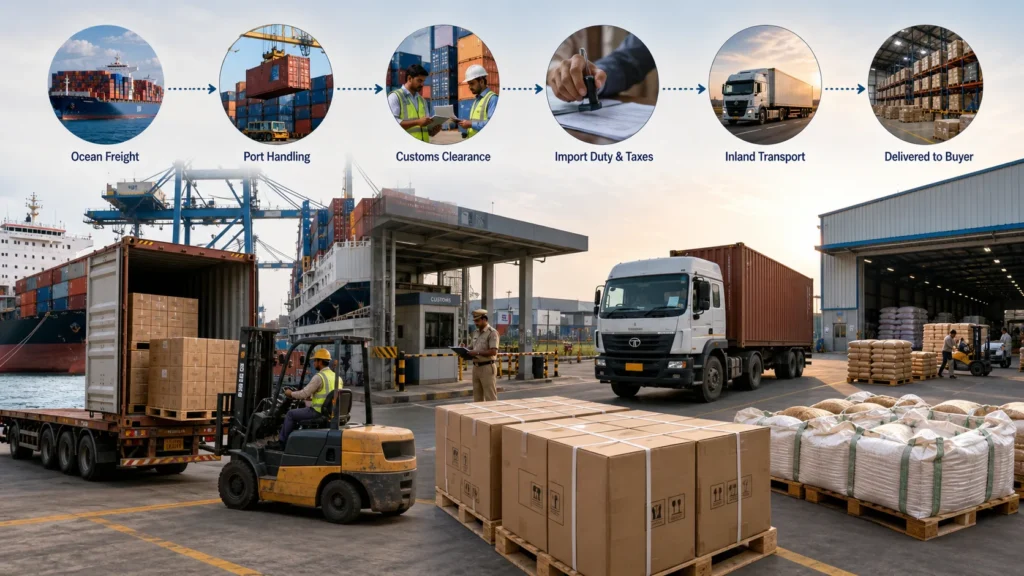
A ship arriving isn’t the same as your goods arriving. Between the vessel and your warehouse sits a stretch of paperwork and invoices: customs brokerage, terminal handling, documentation, inspection or examination where it applies, storage, and assorted port and container charges.
These charges are easy to overlook when you set an FOB or CIF quotation beside a local selling price. A good landed-cost calculation puts them on the table before you place the order, not after the container shows up.
7. Add Inland Transportation
Your port and your warehouse may be hundreds of kilometres apart. Whatever it costs to get the goods from one to the other (to a warehouse, cold store, processing unit, distribution centre or wherever you actually receive them) belongs in the calculation if you want the true delivered cost at that point.
With agricultural products, time adds a wrinkle. A delay in transport can mean extra storage or handling charges. For products with limited shelf life, it can also eat into the amount of product that remains commercially usable.
8. Consider Product-Specific Agricultural Compliance Costs
Agricultural goods can carry requirements that go well beyond an ordinary commercial invoice. Depending on the product and the destination, an importer may need phytosanitary documentation, inspection, laboratory testing, treatment, certificates or other regulatory approvals. Each can cost money. Each can cost time.
A sensible place to begin is APEDA, which publishes export procedures and importing-country regulations for agricultural exports.The practical lesson is an old one: find out what’s required before the shipment is booked. Discovering it after the cargo arrives is the expensive way to learn.
9. Don’t Confuse Supplier Price With Landed Cost
Imagine two quotations on your desk. One is FOB. The other is CIF. Which is cheaper?
You can’t tell yet, because one of them has already paid for part of the journey. The CIF price includes carriage to the destination port and insurance; the FOB price doesn’t.Put them side by side as they stand and the comparison tilts before you’ve done any arithmetic.
The same logic applies to offers from different origins. A lower ex-supplier price doesn’t automatically mean a lower delivered cost. The fix is to put every offer on a common basis, such as landed cost per kilogram at your warehouse, and compare those instead.
10. For Fresh Produce, Calculate Cost Per Sellable Unit
Here’s a wrinkle that belongs to fruit and vegetables: not every kilogram that ships is a kilogram that sells at the price you planned for. So for fresh produce, add one more calculation:
Effective cost per sellable kilogram = Total shipment cost ÷ Quantity that is actually saleable
Take the USD 13,395 from the example. If all 10,000 kg sells, that’s USD 1.3395 a kilo. If only part of it does, the same money is spread over fewer kilos, and the cost of each sellable one goes up.
Packaging, handling, temperature control, transit time, storage and product condition all shape the bottom half of that equation, even when the invoice price never moves. How much loss to expect, if any, should come from your own experience with the product and the route, not from a rule of thumb.
11. A Pre-Order Landed-Cost Checklist
Before you approve an order for agricultural products from India, make sure you can answer each of these:
- Product specification: grade, variety, size, moisture or other agreed quality parameters, packaging and tolerance
- Quantity: net quantity, gross weight and packing configuration
- Incoterm: rule plus the exact named place or port
- HS classification: the classification used by the importing country
- Origin: whether any preferential tariff treatment may apply
- Freight and insurance: the assumptions used in the quotation
- Customs valuation: the method and value expected by the destination customs authority
- Import duty and taxes: actual tariff, import VAT/GST or other applicable taxes
- Destination charges: broker, terminal, inspection, storage and other local costs
- Inland transport: cost to the actual receiving point
- Compliance: phytosanitary, inspection, testing and other product-specific requirements
The Number That Matters
An Indian supplier can offer a very competitive price, and that’s good news. It just isn’t the whole story.
The question worth asking is this: What will this shipment cost me when it reaches my market and is ready for me to receive or sell?
Once you have that figure, everything else gets easier. You can set it against local wholesale prices, competing origins, the price you expect to sell at and the margin your business needs.
And here’s the quiet part: doing this properly doesn’t make an Indian supplier look more expensive, or less. It makes the comparison honest.
Final takeaway
Product price → Freight → Insurance → Import duty → Destination taxes → Port/clearance charges → Inland transport → Other applicable costs
Then turn the total into a unit you can work with: cost per kilogram, per carton or per tonne. That’s the number that tells you whether a shipment fits the commercial reality of your market.
Important: Tariffs, customs valuation, import taxes and agricultural import requirements vary by country, product, HS classification, origin and transaction structure. The numerical example in this article is hypothetical and is not a quotation or customs-duty estimate for any real shipment.
Research References
1. ICC – Incoterms® 2020: FOB explanatory notes and obligations – https://library.iccwbo.org/content/tfb/BOOKS/BK_0049/BK_0049_05_RulesSea.htm
2. ICC – Incoterms® 2020 checklist and flowcharts – https://library.iccwbo.org/content/clp/Others/incoterms_2020_checklist_2024-update.pdf
3. WTO – Agreement on Implementation of Article VII of GATT 1994 (Customs Valuation Agreement), Articles 1 and 8 – https://www.wto.org/english/docs_e/legal_e/20-val_01_e.htm
4. Dubai Customs – Frequently Asked Questions (customs value and duty rate) – https://www.dubaicustoms.gov.ae/en/mobile/pages/faq.aspx
5. ICEGATE – Trade Guide on Imports / Customs Duty Calculator – https://www.icegate.gov.in/Webappl/Trade-Guide-on-Imports | https://www.icegate.gov.in/cdc
6. CBIC – Integrated GST Act, 2017, Section 16: Zero rated supply (current text, as amended) – https://taxinformation.cbic.gov.in/content/html/tax_repository/gst/acts/2017_IGST_Act/active/chaptervii/section16_v1.00.html
7. APEDA – Export procedures and importing countries’ regulations (Quality section) – https://apeda.gov.in